
Blog brief reader task test
A practical test for finding out whether a draft helps an unfamiliar reader complete the task promised in its brief.
blog brief reader task test
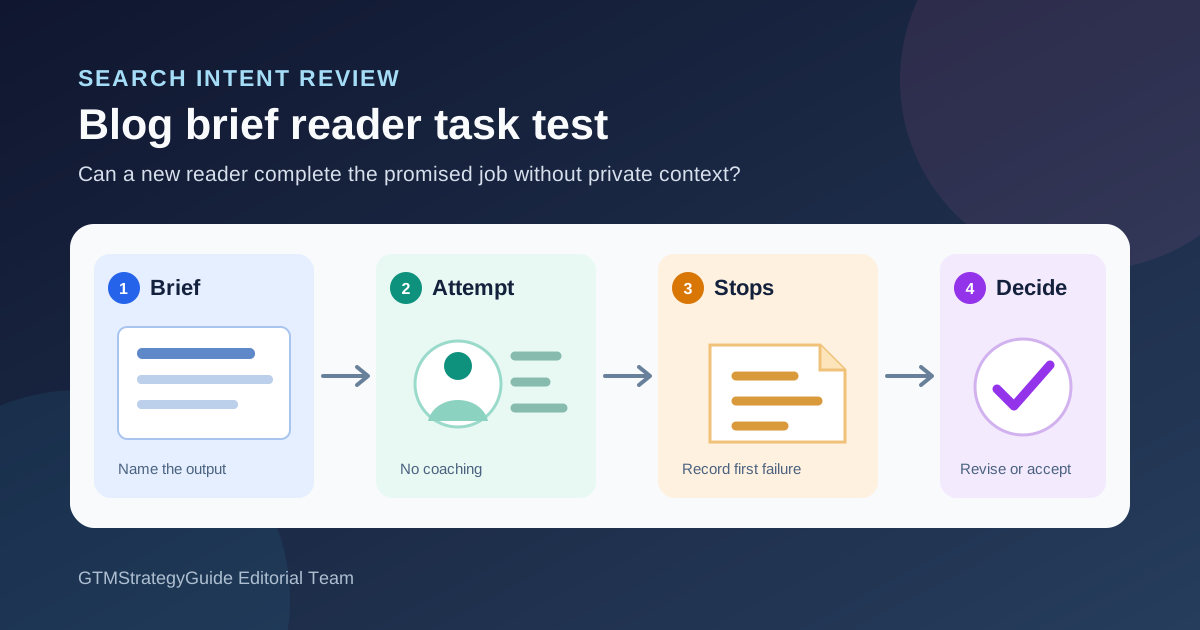
A blog brief reader task test checks whether someone can use a draft for the job the brief promises. The reviewer receives the same entry context a visitor would have, then tries to make the decision, follow the procedure, or produce the output named in the brief. The editor watches for missing information and misleading turns instead of asking whether the article sounds good.
This test belongs after a draft has a complete shape but before line editing makes it expensive to reorganize. It can expose a brief that combines incompatible jobs, a draft that answers a nearby question, or a promised tool that exists only as a heading.
A familiar teammate is often a poor first reviewer because private context fills the gaps. Choose someone who understands the audience but did not attend the planning discussion, and give that person permission to stop when the page stops helping.
Turn the page promise into an observable task
Copy the page promise from the approved brief and rewrite it as an action the reviewer can attempt. A promise to explain content consolidation is too loose for a task test. A reviewer can, however, use the draft to choose whether two sample pages should stay separate, be differentiated, or be combined.
Name the minimum useful output before the session, and make it match the article type rather than a generic request to summarize what was learned. For a comparison article, that might be a choice with the criteria that drove it. For an implementation guide, it could be a completed setup with a record of the checks that passed.
Also write the stopping boundary. A brief about choosing a method need not teach every installation step, but it should tell the reader what happens after the choice and where the detailed procedure lives. A visible boundary is more honest than quietly abandoning the task halfway through.
Build a test packet without hidden help
Give the reviewer the proposed search phrase or referral context, the title, and the draft as it would appear to a reader. Include a realistic scenario with only the facts the intended audience would normally know. Do not attach the planning notes, source matrix, or explanation the writer used to make sense of the piece.
Prepare one ordinary case and one case that presses on a stated exception. The ordinary case shows whether the main path is usable. The exception shows whether qualifications and handoffs are clear when the default advice does not fit.
Keep the packet small enough that the article remains the primary source of help. If the reviewer needs a page of verbal instructions to begin, the setup is hiding a weak opening or an undefined audience. Record any clarification you feel tempted to give, because that missing context may belong in the brief or draft.
Separate comparison tasks from implementation tasks
A query can use the same topic words while asking for a different kind of work. Someone comparing editorial calendars needs selection criteria, tradeoffs, and a way to distinguish the options. Someone implementing the chosen calendar needs fields, ownership rules, and a sequence for putting it into use.
Do not ask one short article to pass both tests unless the brief explicitly provides both paths and enough evidence for each. When reviewers repeatedly leave the comparison to search for setup instructions, decide whether the draft needs a clear handoff or whether the implementation task deserves its own route.
The reverse failure matters too. A procedural draft may open with so much category education that an already committed reader cannot find the first action. Keep background that prevents a costly mistake, then move the general comparison material to the page built for that decision.
Observe the attempt without coaching it
Ask the reviewer to say what they expect at each major turn and to mark the first point where confidence drops. Useful notes identify the passage, the expected answer, and what the reviewer did next. A comment such as confusing gives the editor less to work with than I expected a decision rule here, so I opened another result.
Do not defend the draft during the attempt. Questions, hesitation, rereading, and abandoned steps are evidence about the path the page creates. Answer only when the test cannot continue, then record the exact intervention and treat everything after it as a supported attempt rather than an independent one.
A reviewer can dislike the tone and still complete the task, or enjoy the article and fail to use it. Capture editorial reactions separately from task failures. This keeps a strong opinion about style from obscuring a missing criterion, example, warning, or next action.
Diagnose the brief before patching the prose
Trace each stop to one of four places: the promised task, the assumed audience knowledge, the draft structure, or the supporting evidence. If the promise names two outcomes with different users, rewriting a transition will not solve the problem. Split or narrow the brief first.
When the brief is sound, revise the smallest part of the draft that restores the path. Add the missing criterion where the decision occurs, move a warning before the risky step, or replace an abstract example with one that exercises the stated method. Avoid adding a general explanation to every section just because one reviewer needed context in one place.
Keep disagreements visible. One reviewer may bring less domain knowledge than the defined audience, while another may expose an assumption that the team never wrote down. The accountable editor should compare the observation with the audience definition and record why the draft changed or stayed as it was.
Repeat the task and close the record
Run the revised path with a fresh reviewer when the change affects the promise, sequence, or required output. Giving the same person a second attempt can show whether a repair is clearer, but memory now supplies context that a new reader will not have. Use the second attempt as supporting evidence, not a clean replacement for the first.
Close the test with the task, scenario, draft version, reviewer context, observed stops, interventions, editorial decisions, and accepted result. Link the record to the brief so later edits do not remove a qualification or example that made the task workable.
After publication, inspect the canonical route from the same entry point. Confirm that the title, H1, opening answer, links, media, and visible steps match the tested draft. A passing document test does not cover a rendering defect, missing link, or component that changes the order readers actually see.
Sources
- Creating helpful, reliable, people-first content, Google Search Central. Supports checking whether an intended audience can use the content to achieve its goal and seeking an honest assessment from someone unaffiliated with the site.
Related GTM guides
Frequently asked questions
Who should run a blog brief reader task test?
Use a reviewer who understands the intended audience but did not help plan or draft the article. The editor owns the test record and decisions, while the reviewer attempts the task without receiving private context.
When should a brief be split into two articles?
Split it when the promised tasks require different audiences, evidence, structures, or outputs and neither path can be completed without crowding out the other. Comparison and implementation commonly need separate tests even when they share a topic.
What counts as a failed reader task test?
The test fails when the reviewer cannot reach the promised output from the supplied entry context, needs hidden instructions, follows an unsafe or misleading sequence, or discovers that the draft answers a different job. Record the first stop and its consequence before revising.