
Content brief source minimum
A practical way to decide which sources a content brief needs without rewarding an arbitrary citation count.
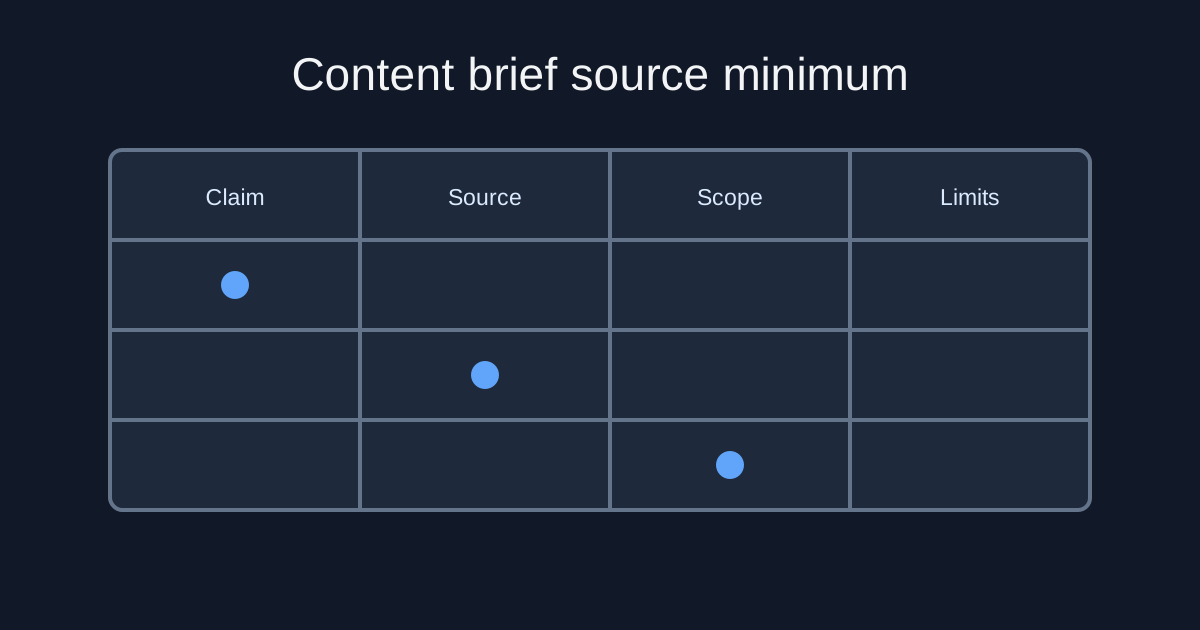
content brief source minimum
The useful minimum is not a fixed number. It is the smallest evidence set that supports the claims the planned article actually needs to make. Begin the brief with the reader's decision, then list the facts, definitions, examples, and interpretations required to help with that decision.
A narrow explanation may rest on one direct authoritative document. A comparison across markets may need several independent records because no single source covers the whole scope.
Counting links before mapping claims creates the wrong incentive. Three articles that repeat the same press release do not provide three independent views. Ten loosely related sources can still leave the decisive sentence unsupported.
Put a source beside a proposed claim only when the source speaks to that claim's subject, population, date, and qualification. If the fit is partial, narrow the planned language or mark a research gap.
Build a claim and evidence table
Give each consequential claim its own row. Record the draft claim, why the reader needs it, the preferred source owner, publication date, direct URL, relevant passage, and known limitation. Classify the row as observed fact, sourced definition, calculation, practitioner experience, or editorial interpretation.
These labels help the writer avoid turning an interview example into a market pattern or presenting a local policy as a universal rule.
Set the evidence burden from consequence, volatility, and specificity. A stable definition from the body that maintains it may need one source. Current pricing, legal duties, safety instructions, benchmark ranges, and claims about groups deserve closer review because context or timing can change the answer.
The brief should not pretend that one formula decides adequacy. It should make the editor's reasoning inspectable before prose hardens around it.
Decide whether the set is sufficient
Run three passes. First, check coverage: does every necessary factual claim have direct support? Second, check fit: does each source support the exact wording rather than a neighboring idea?
Third, check independence: are apparently separate sources relying on the same underlying announcement, dataset, or expert? Record failed checks openly. A missing source is useful planning information, while a decorative citation gives the writer false confidence.
Primary material is usually the clearest starting point for what an organization says, what a standard requires, or what a dataset reports. Secondary analysis can add interpretation or expose disagreement. Practitioner interviews can explain lived process, but attribution and scope still matter.
Choose sources by their role in the article instead of treating primary, secondary, and experiential material as interchangeable tokens in a quota.
Handoff rules for writers and reviewers
The writer may discover that a source does not survive close reading. Give them permission to narrow, remove, or return the claim rather than filling the gap with confident connective prose. Preserve the source passage and qualification in the handoff so the reviewer can reproduce the decision without reopening every tab.
If an expert interview is planned, ask questions tied to marked gaps and separate quotable experience from general conclusions.
Before approval, sample the highest consequence claim, the newest claim, and one claim based on interpretation. Open the direct source, locate the supporting passage, and compare it with the draft. Then inspect the full bibliography for duplicated origins and stale dates.
The source minimum is met when the necessary claim set is covered at the right scope. It is not met merely because the reference list looks substantial.
Handle volatile and disputed material
Mark claims that can change before publication, including current features, prices, policies, personnel, and product availability. Give each one a last verification date and a named owner. If the source changed after drafting, compare the new version with the sentence instead of assuming the earlier citation still supports it.
When credible sources disagree, preserve the disagreement in the brief. Record the definitions, periods, populations, and methods that may explain the difference, then decide whether the article needs both accounts or a narrower claim. A writer should not average incompatible figures or select the most convenient source without documenting why it fits the reader's question.
Keep the source set usable
Prefer direct links to the specific document, table, policy, or page used for the claim. Save the source title, publisher, publication or revision date, access date, relevant passage, and qualification in the brief. A homepage link or search result forces the next reviewer to repeat the research and may conceal that the evidence moved.
Remove decorative sources before handoff. Every retained item should support a mapped claim, define the reader's context, or document a material disagreement. This keeps the bibliography short enough to inspect while leaving a clear reason for each source to exist.
Sources
- Creating helpful, reliable, people-first content, Google Search Central. Provides source and trust review questions that support matching claims to direct evidence and visible expertise.
Related GTM guides
Frequently asked questions
Is one source ever enough for a content brief?
Yes, when one direct authoritative source fully supports a narrow, low ambiguity claim and the article does not extend beyond it. Record the relevant passage and limitation. Add sources when the planned wording combines contexts, makes a comparison, or depends on interpretation.
Should every sentence in the brief have a citation?
No. Map citations to checkable factual claims and clearly label calculations, experience, and editorial interpretation. The goal is traceable support for consequential statements, not a link attached to ordinary transitions or advice that is plainly presented as a working method.
What happens when two sources disagree?
Record their definitions, dates, populations, methods, and qualifications before choosing wording. Present the disagreement when it matters to the reader, or narrow the claim to the evidence that can be supported without hiding the conflict.