
Content cannibalization decision record
A route-by-route record for deciding whether overlapping pages should stay distinct, change scope, consolidate, or retire.
content cannibalization decision record
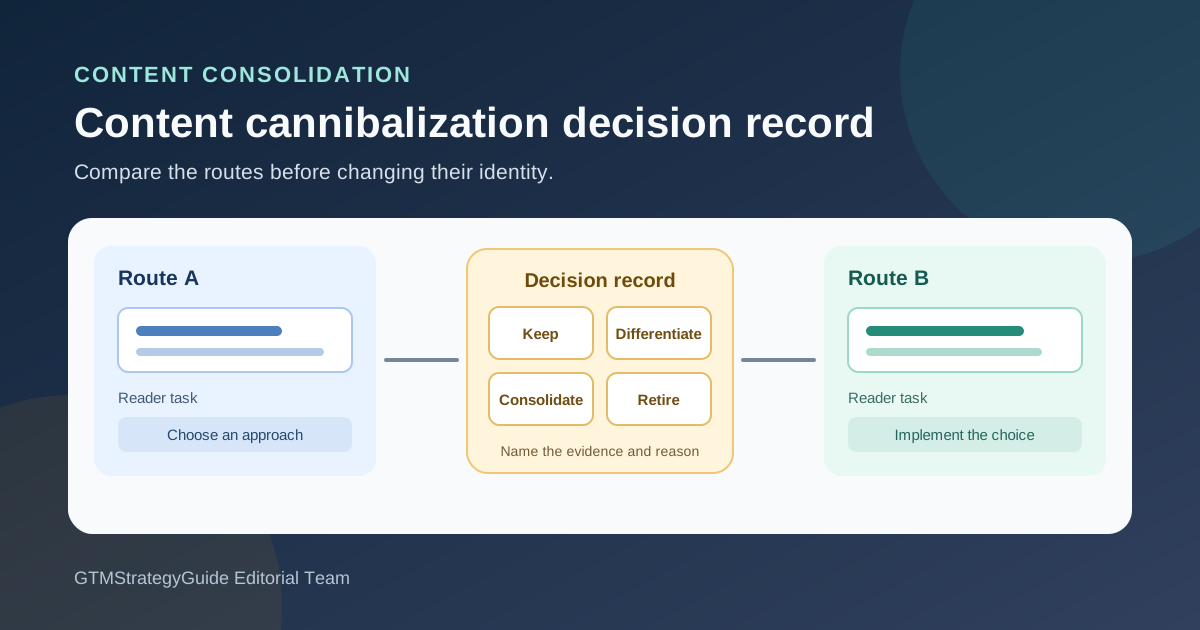
A content cannibalization decision record explains what two or more pages are trying to do and why the team chose to keep, change, combine, or retire them. It begins with routes and reader tasks, not a chart showing that the same query produced more than one URL. Two pages can appear for related searches and still serve different people at different points in their work.
The record protects the team from a common overreaction: deleting a useful page because its vocabulary overlaps with another route. It also prevents the opposite mistake, where editors keep near copies alive because each page once had a separate brief.
Open a record when repeated topics create a real decision about route identity. Name the affected URLs, the observation that prompted review, the accountable editor, and the date of the evidence so someone else can reproduce the starting point.
Capture the evidence before naming the problem
Save the exact query and page sets, date range, country, device, and search appearance behind the concern. Note whether the pages trade places, appear together, or receive different queries within the topic. A blended site total can hide one route gaining a distinct audience while another loses demand for unrelated reasons.
Read both pages in full. Record each title, description, H1, opening answer, major sections, conversion action, internal links, cited evidence, and declared canonical URL. Then write the job a reader can complete on each route without copying the keyword from its metadata.
Add non-search evidence when it changes the decision. Backlinks may point to a particular tool or passage, while assisted conversions may show that a low-traffic page answers a later question. Label every source and limitation instead of turning a partial signal into a verdict.
Compare reader task and page promise
Place the two route summaries side by side and ask whether an unfamiliar reader could predict which one to choose. Distinct routes need a meaningful difference in audience, decision, format, evidence, or stage of work. A few rewritten headings do not create that difference when both pages still lead to the same answer.
Test the opening and the promised output. A comparison page may help a reader select an approach, while an implementation page helps put the chosen approach into practice. Those routes can coexist when their titles, internal anchors, examples, and next actions make the handoff plain.
If the distinction exists only in the original briefs, treat it as unproven. The visible pages must carry it. Record passages that support the difference and passages that collapse it, since the eventual edit should fix the route a reader encounters rather than the intent stored in a planning file.
Choose among four route decisions
Preserve both pages when each serves a defensible task and the route signals agree with that purpose. The record should state the distinction in one sentence and list any small edits needed to make it obvious. Preservation is an active decision, not permission to ignore confusing anchors or duplicated openings.
Differentiate the pages when both tasks deserve a route but the current copy blurs them. Assign one clear promise to each URL, then revise titles, H1s, openings, section scope, and internal links together. Avoid dividing the topic by word count or arbitrary funnel labels that readers cannot see.
Consolidate when the useful material answers the same task and maintaining two routes adds no reader benefit. Retire without a replacement when a page is inaccurate, obsolete, or purposeless and no destination satisfies the same need. Write the reason before making either change so a convenient redirect does not substitute for an equivalent destination.
Plan consolidation without losing useful material
Choose the surviving route based on reader fit, content completeness, link history, conversion role, and operational stability. Do not pick it only because its current traffic is higher. A temporary ranking difference may be less important than the URL that matches the lasting task and can absorb the strongest material cleanly.
Map every section of the retiring page to keep, rewrite, move, or remove. This forces the editor to account for useful examples, qualifications, media, and source links before the redirect is configured. It also exposes material that belongs on a separate route because it serves another job.
Use a permanent redirect only when the destination is a genuine replacement for the old page. Google documents redirects as a strong canonical signal, but a search signal does not make an irrelevant destination helpful. If no equivalent page exists, record the retirement response and repair inbound paths instead of sending every old URL to a broad hub.
Align every route signal with the decision
A consolidation decision touches more than body copy. Update internal links to point directly to the surviving route, remove the retired URL from owned indexes and recursive sitemaps, and confirm that the destination has a self-referencing canonical. Check titles and H1s so the survivor does not retain a promise that conflicts with the material it absorbed.
For differentiated pages, inspect canonical tags before assuming they can both remain discoverable. A canonical from one distinct route to the other contradicts the decision, while a sitemap that lists a retired URL sends another inconsistent signal. The record should name the expected value for each route rather than saying metadata checked.
Keep a rollback note for behavior that can be reversed, but do not preserve contradictory live signals as a precaution. The accepted decision should appear consistently in redirects, navigation, contextual links, metadata, schema, and sitemap ownership.
Verify the release and close the record
After release, request every affected URL without relying on a browser cache. Record the response status and redirect destination, then inspect the final canonical tag, title, H1, visible answer, internal links, media, and structured data. Crawl known source pages to confirm they no longer send readers through an avoidable redirect.
Check the sitemap and blog index separately. A route can disappear from navigation while remaining in a nested sitemap, or leave the sitemap while an index card still promises it. Save the immutable release reference and verification time beside the ordered list of tested URLs.
Close the record with the chosen decision, rejected alternatives, evidence limitations, and the condition that would justify another review. Do not claim that consolidation fixed ranking competition. The record proves that the site now presents a deliberate route structure and gives the next editor a clear basis for revisiting it.
Sources
- How to specify a canonical URL with rel=canonical and other methods, Google Search Central. Documents redirects, canonical annotations, and sitemap inclusion as signals used to identify a preferred URL for duplicate or very similar pages.
Related GTM guides
Frequently asked questions
Do two pages ranking for the same query prove content cannibalization?
No. Preserve the query, page, date, device, country, and search appearance first, then compare the reader task and visible promise of each route. Related pages can share vocabulary while serving different decisions or stages of work.
When should overlapping pages be consolidated?
Consolidate when their useful material serves the same reader task and separate maintenance adds no clear benefit. Choose the surviving route by reader fit, completeness, link history, conversion role, and stability, then account for every useful section before redirecting.
What must be checked after a cannibalization decision is released?
Request every affected URL and verify response status, redirects, canonical tags, titles, H1s, visible content, internal links, media, schema, indexes, and recursive sitemaps. Save the immutable release reference and the exact routes tested.