
Content citation maintenance routine
A practical routine for checking whether a published source still supports the exact claim, qualification, and reader task attached to it.
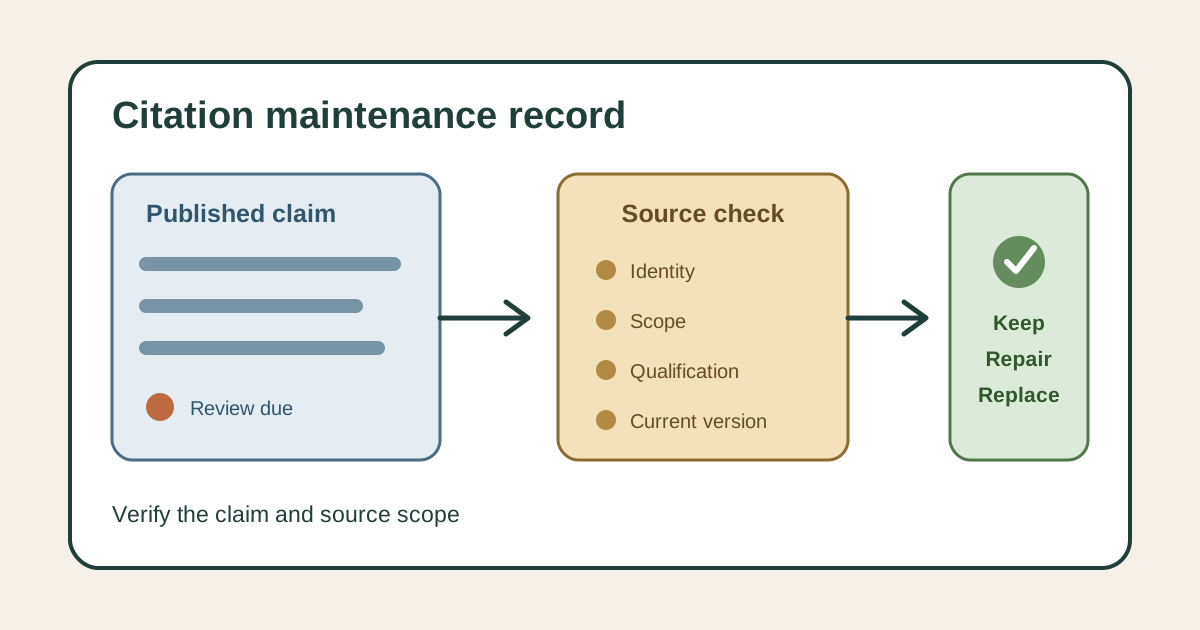
content citation maintenance routine
A content citation maintenance routine checks more than whether an external link still opens. A source can move, change its wording, narrow a recommendation, replace a dataset, or remain online while no longer supporting the sentence beside it. The review must compare the published claim with the current source itself.
Create one record for each governed citation. Include the canonical article route, section, exact supported claim, source title, publisher, direct URL, source owner when known, original access date, volatility, relevant qualification, and the editor responsible for the next review.
Keep the record close to the content workflow without exposing internal notes on the public page. A future reviewer should be able to find the claim and source without relying on browser history, an old message, or the memory of the original writer.
Choose which citations to review first
Start with claims that can change quickly or cause a larger reader consequence. Product behavior, pricing, legal requirements, official instructions, active policies, current dates, and changing datasets deserve earlier attention than a stable definition from a durable primary source.
Use page changes as another trigger. Review citations when a factual section is edited, the page changes audience or scope, a linked source redirects, a reader reports a conflict, or a scheduled check reaches its due date. Do not reset the review date merely because an automated request returned a successful status.
Record why the citation entered the queue. A named trigger makes the review easier to audit and prevents a high traffic page from displacing a quieter page whose outdated instruction could mislead the reader.
Open the source and inspect its identity
Request the direct source URL and follow its response chain. Confirm the final hostname, publisher, page title, publication or revision date when shown, language, and document version. Watch for a redirect that lands on a home page, search page, newer document, or generic support index.
A new destination may be useful, but it is not automatically the same evidence. Compare authorship, scope, date, and the passage that carried the original claim. Save enough detail to explain whether the source moved intact, was superseded, or became unavailable.
Prefer the primary material when it is available and fits the claim. A summary can help a reader understand context, but it should not stand in for the governing policy, original research, product documentation, or first party announcement when the article relies on that source's exact statement.
Compare the claim with the source scope
Read the complete published sentence and the surrounding paragraph before checking the citation. Identify the subject, action, population, location, period, conditions, and degree of certainty. Then find where the source supports each part rather than matching a few shared words.
Check qualifications that may sit in a note, table heading, methodology section, eligibility rule, or later update. A claim about all users is not supported by evidence limited to one plan or region. A general performance statement cannot come from a single example unless the copy identifies it as an example.
Google Search Central includes clear sourcing and the absence of easily verified factual errors in its questions for assessing trustworthy content. The useful editorial test is direct: can another reviewer follow the citation and see why this source supports this wording?
Choose keep, repair, replace, or remove
Keep the citation when the source identity, relevant passage, and claim scope still agree. Update only the maintenance record when nothing reader visible has changed, and preserve the review date and reviewer rather than altering the article's modification date without a material edit.
Repair the link when the same source has a stable new location. Replace it when a better primary source supports the same claim, but reread the sentence against the replacement instead of assuming two sources say the same thing. Record the old URL and reason for the change.
Narrow or remove the claim when current evidence supports less than the published wording. If the disputed statement affects the page's main conclusion, route the edit through the responsible editorial review rather than treating it as a silent link fix.
Update every representation of the citation
Search the repository and rendered site for the old URL, source title, and affected claim. The same evidence may appear in another article, a research page, footnote data, downloadable file, structured field, or generated source list. Each use needs its own scope check because nearby wording may differ.
Update the visible link label and source note when the source identity changes. Keep labels descriptive enough that a reader can judge the destination before opening it. Do not copy tracking parameters, private preview tokens, or credentials into published URLs or maintenance records.
Check internal pages that summarize the corrected claim. A citation repair is incomplete when the canonical article is accurate but a Blog index description, related guide, or distributed excerpt still carries the earlier statement.
Validate the release and close the record
Run the normal content and repository gates after any reader-visible change. Render the canonical route and verify the claim, qualification, label, destination, byline, dates, metadata, schema, internal links, media, Blog index, and sitemap ownership. Confirm that the external request reaches the intended authoritative page without an unexpected redirect.
Tie approval to the exact reviewed revision. After deployment, request the live page, open the citation from the rendered content, and save the deployed revision, verification time, final URL, and result. A merged edit or deployment start does not prove the corrected citation is public.
Close the entry with keep, repair, replace, remove, or escalate as the outcome. Set the next review from the claim's volatility and the source's change pattern, and retain the earlier decision so later editors can distinguish a deliberate update from unnoticed drift.
Sources
- Creating helpful, reliable, people-first content, Google Search Central. Supports assessing content for clear sourcing, trustworthy presentation, and the absence of factual errors that readers can verify.
Related GTM guides
Frequently asked questions
How often should published citations be reviewed?
Set the interval from the claim's volatility and reader consequence. Review sooner when a page changes, a source redirects, a reader reports a conflict, or the evidence covers product behavior, policy, pricing, dates, or another changing subject.
Is a working link enough to keep a citation?
No. Open the source and confirm its identity, current version, relevant passage, qualifications, and scope. A successful request can still lead to revised evidence or an irrelevant destination.
What should happen when a source no longer supports a claim?
Repair the link when the same evidence moved, replace it with a primary source that supports the same wording, or narrow or remove the claim. Escalate the edit when it changes the page's main conclusion.