
Content distribution handoff note
A practical handoff for giving each distribution owner the approved message, canonical destination, media, timing, exclusions, and correction path.
content distribution handoff note
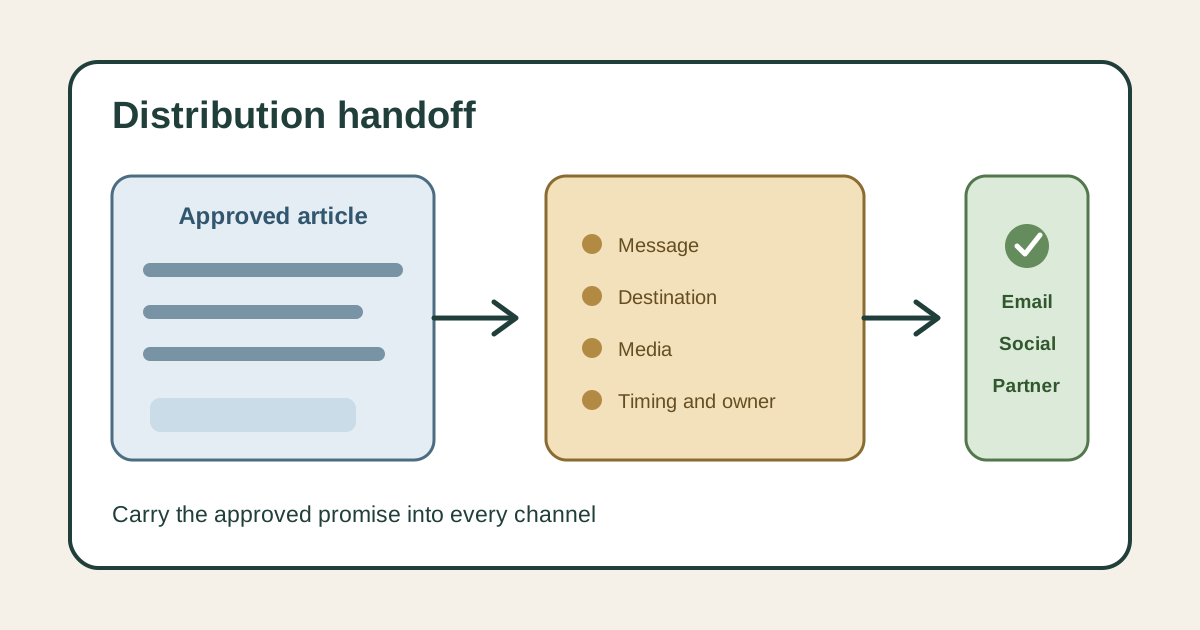
A content distribution handoff note gives a channel owner enough context to share a published article without changing its promise. Copying the headline into every channel is not a handoff. The owner also needs the intended reader, approved claim, destination, media, timing, exclusions, and a way to report or correct a mistake.
Create the note only from accepted article copy. Record the canonical route, immutable reviewed revision, article title, focus task, audience, accountable editor, distribution owner, approved channels, earliest send time, and the evidence that must be visible on the live page before scheduling begins.
Keep draft links and private review comments out of the note. A distributor should not have to guess whether a preview, temporary asset, or unresolved claim is ready for public use.
Confirm the destination before writing channel copy
Request the canonical URL and inspect its response, title, H1, opening answer, byline, media, source links, and next action. Confirm that the page matches the reviewed revision and that the Blog index and sitemap identify the same route. A merge or deployment start is not enough.
Use the canonical page as the destination identity. If a channel requires measurement parameters, keep the base URL unchanged in the record and generate the channel URL from the approved naming scheme. Preserve the exact parameter values so reporting does not split because of spelling or case differences.
Google Analytics documents campaign parameters for identifying referral traffic and recommends consistent values for source, medium, and campaign. The handoff should list the final governed URL rather than asking each owner to invent tags while scheduling.
Define the approved message boundary
Write one plain sentence that states what the article helps the reader do. Then list the factual claims a channel may use, the qualification that must travel with each claim, and any wording that has not been approved for distribution. Link every external fact back to its source decision.
Separate the article's conclusion from a promotional interpretation. A guide that explains how to review a process does not prove an outcome, speed, or universal fit. Channel copy may become shorter, but it cannot become more certain than the page it introduces.
Include the approved title and one or two alternate openings when the workflow permits them. Mark which words are fixed because they preserve accuracy, consent, product identity, or another review decision.
Adapt the opening to the channel
Describe the audience and context for each channel. A newsletter reader may already know the publication, while a social feed visitor may need the subject and value stated immediately. Adapt the opening to that context without inventing urgency, proof, scarcity, or a different reader task.
Specify length, formatting, link, and accessibility requirements that the channel owner must meet. If a platform truncates text, put the accurate core message before the cut. Do not hide a qualification after the part most readers will see.
Name the action the channel should invite. It may be reading the guide, using a checklist, reviewing a decision, or contacting the team after the article has explained fit. The action should exist on the destination and make sense for the stated audience.
Package owned media and accessible text
Attach the approved asset path, dimensions, format, crop guidance, rights record, and intended channel use. Include text alternatives or captions written for the asset's purpose in that placement. A social crop can remove a label or change the meaning even when the source image passed the article review.
Provide a fallback when the preferred asset cannot be used. The fallback may be another approved crop or text-only distribution, but it should not be an unreviewed stock image that implies a customer, result, location, or product behavior the article never establishes.
Check embedded words at the smallest supported size. If the channel image contains essential information that cannot remain legible, move the information into the post text or use a simpler approved asset.
Set timing, ownership, and correction rules
List the earliest distribution time as a condition, not an assumption. The live route, asset, and required proof must be available first. Name who confirms publication, who schedules each channel, who monitors the destination, and who can pause or correct a queued message.
Record timing conflicts such as a product change, policy review, embargo, outage, or another campaign speaking to the same audience. Do not create false urgency to protect a calendar slot. Move the handoff when the destination or approved claim is no longer current.
Give the owner a correction path with a response contact and expected decision point. If the article changes after scheduling, compare the queued copy with the new page before it is sent.
Verify distribution and close the note
Preview each scheduled item in the channel interface. Check the visible opening, truncation, destination, campaign parameters, media crop, alternative text, account identity, timing, and any disclosure required by the approved message. Save the preview state or review reference without exposing credentials.
After the item is public, request the destination from the distributed link and confirm the route still resolves to the expected canonical article. Inspect the live channel text and media for substitutions made during publishing. A scheduled status does not prove that the approved handoff reached readers.
Close the note with the live channel URL or durable message identifier, publication time, owner, result, and any correction. Preserve cancelled and corrected versions so later reviewers can distinguish an intentional change from an unexplained mismatch.
Sources
- URL builders: collect campaign data with custom URLs, Google Analytics Help. Documents campaign URL parameters for identifying referral traffic and recommends consistent naming for source, medium, and campaign values.
Related GTM guides
Frequently asked questions
What belongs in a content distribution handoff note?
Include the audience, approved message and qualifications, canonical destination, governed channel URL, media and text alternative, timing conditions, owner, exclusions, required preview checks, and correction path.
Can channel copy differ from the article headline?
Yes, when the opening is adapted to the channel's audience and format without changing the reader task or claim scope. The shorter copy cannot add urgency, proof, or certainty that the article does not support.
When is a distribution handoff complete?
Close it after the channel item is public, the distributed link reaches the expected canonical article, and the live text, media, timing, and measurement parameters match the approved note. Record cancellations and corrections as outcomes too.