
Editorial calendar dependency check
A practical review for finding the evidence, review, media, engineering, and distribution work that can move a planned publication date.
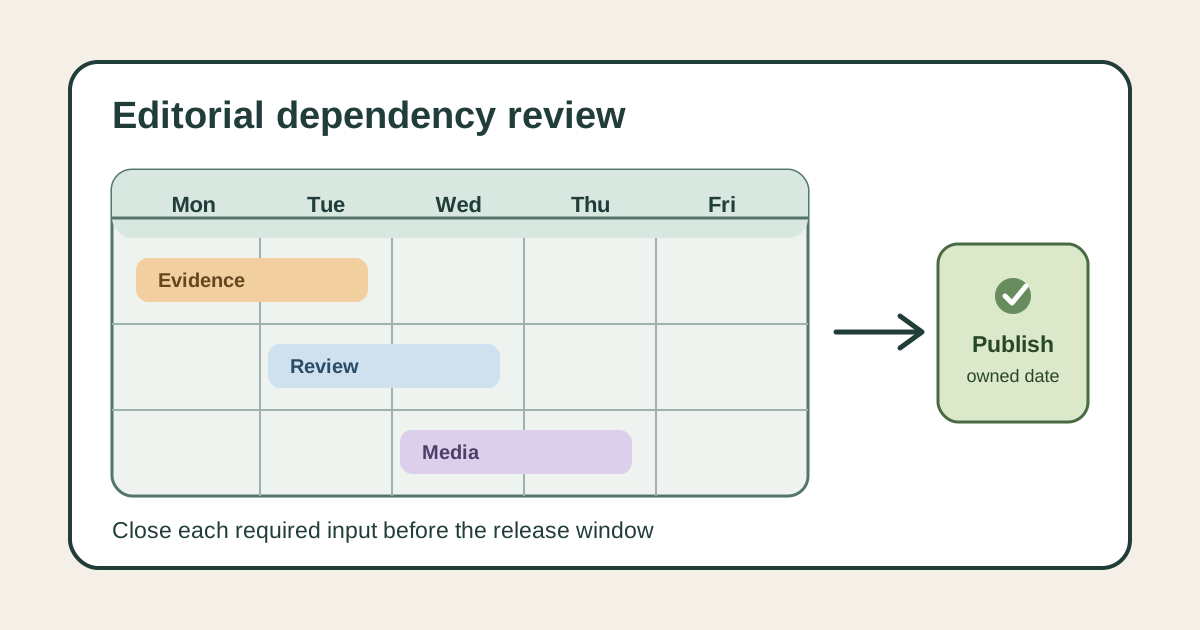
editorial calendar dependency check
An editorial calendar dependency check tests whether a planned publication date is supported by the work that must happen first. A date can look settled while source delivery, an interview, product facts, review, media, engineering, or distribution work still has no owner. The calendar should expose those conditions before a writer has to absorb every delay at the end.
Review dependencies when a brief enters the calendar, when its scope changes, and before the final release window. The check should end with an owned path to publication or an honest date change, not a colored status that hides uncertainty.
Open one dependency record for the article. Include the canonical working title, intended reader task, target route, planned publication date, accountable editor, current stage, and the immutable revision used for the latest review.
Define what the date actually promises
Teams often use one date to mean several things: draft complete, editorial approval, merge, deployment, or public availability. Write the promised event beside the date so nobody plans distribution around a draft deadline or treats a successful build as proof that the page is live.
State the release conditions in plain language. A standard article may need accepted copy, claim support, reviewed links, approved media, valid metadata, a green repository state, and live route verification. A page with product, policy, or legal consequences may need named reviewers who are not part of the usual path.
Keep preferences separate from release conditions. A late optional example may improve the article, but it should not hold the schedule unless the brief says the example is necessary to complete the reader task.
List inputs as real dependencies
Walk through the article from evidence to live distribution. Record source delivery, interview availability, product details, policy or legal review, copy edit, original media, accessibility review, engineering changes, repository checks, deployment, and channel handoff only when each item applies.
For every required input, name the deliverable and the person responsible for providing it. Add the earliest useful request date, needed by date, current state, proof location, and the work it blocks. A row that says waiting on product without a question, owner, or decision date does not help anyone resolve the wait.
Map order as well as ownership. Microsoft Support describes task dependencies as relationships that drive a schedule because a predecessor change affects its successor. The same principle applies here: a late approved diagram can move accessibility review, layout inspection, the final build, and the distribution handoff.
Question each dependency before accepting it
Some calendar blockers are habits rather than requirements. Ask what reader or release risk the dependency controls, who has authority to clear it, and whether a smaller deliverable can answer the need. Keep the dependency when removing it would weaken accuracy, consent, accessibility, route integrity, or another explicit acceptance rule.
Do not use this review to bypass a responsible specialist. If legal review is required because the copy makes a regulated claim, the answer is to narrow or remove the claim, obtain the review, or move the date. Relabeling the review as optional does not change the consequence of publishing unsupported wording.
Also check for circular waits. An editor should not wait for final media before approving a concept if the designer cannot finish the media until that concept is approved. Split the work into a reviewable concept decision and a later asset acceptance step.
Set decision points before the deadline
Place a decision point before each dependency can consume the remaining review window. At that point, the accountable editor confirms delivery, accepts a documented substitute, narrows the article, or moves the publication promise. Silence should never convert an unknown input into assumed approval.
Leave enough time after the last content input for the normal quality checks. Compressing claim review, copy edit, build validation, or live verification preserves the calendar date by spending the controls that made the date credible. Move the promise when a required input remains unknown.
Record the consequence of each choice. If an interview is removed, list the claims or sections that must also leave the draft. If a product detail arrives late, identify which review steps must run again because the accepted copy changed.
Run the check during production
Review the dependency record at a short, fixed cadence that fits the release. Focus the discussion on changed dates, missing proof, blocked successors, and decisions due before the next check. Reading every unchanged row aloud adds meeting time without making the calendar more reliable.
Update the article status from evidence. A source link in a message may satisfy source delivery, but it does not prove that the relevant claim was reviewed or that the citation supports the final sentence. The dependency closes only when its stated deliverable and acceptance condition are met.
When scope expands, rerun the map. A new comparison table may add research, design, mobile layout, accessibility, and rendered-page checks even if the title and publication date stay the same.
Review missed dates without blaming the last step
After a missed date, compare the planned dependencies with what actually happened. Group the delay by missing input, unclear ownership, late scope change, unavailable reviewer, rework, technical failure, or an inaccurate planning assumption. Preserve the sequence so the final visible delay is not mistaken for the original cause.
Change the planning rule that failed. Repeated late product facts may require an earlier evidence deadline, while recurring media rework may show that concept approval happens too late. A larger generic buffer will hide the pattern if the same unresolved dependency keeps consuming it.
Close the record after the page is live and verified. Save the published route, deployed revision, verification time, final dependency outcomes, and any change that should affect the next editorial calendar review.
Sources
- Link tasks in a project, Microsoft Support. Explains how predecessor and successor task relationships drive a project schedule when linked work changes.
Related GTM guides
Frequently asked questions
When should an editorial calendar dependency check happen?
Run it when a brief enters the calendar, after a material scope change, and before the final release window. Review it more often when a required input changes or a decision point is approaching.
What information belongs in a dependency record?
Name the required deliverable, owner, request date, needed by date, current state, proof location, acceptance condition, and the work it blocks. Tie the record to the article route, reader task, planned publication event, and reviewed revision.
What should happen when a required input is late?
The accountable editor should obtain the input, accept a documented substitute when the release rules allow it, narrow the article, or move the publication date. Do not protect the date by shortening the final quality or live verification work.