
Editorial claim review workflow
A practical workflow for finding, classifying, sourcing, qualifying, and approving claims before an article reaches publication.
editorial claim review workflow
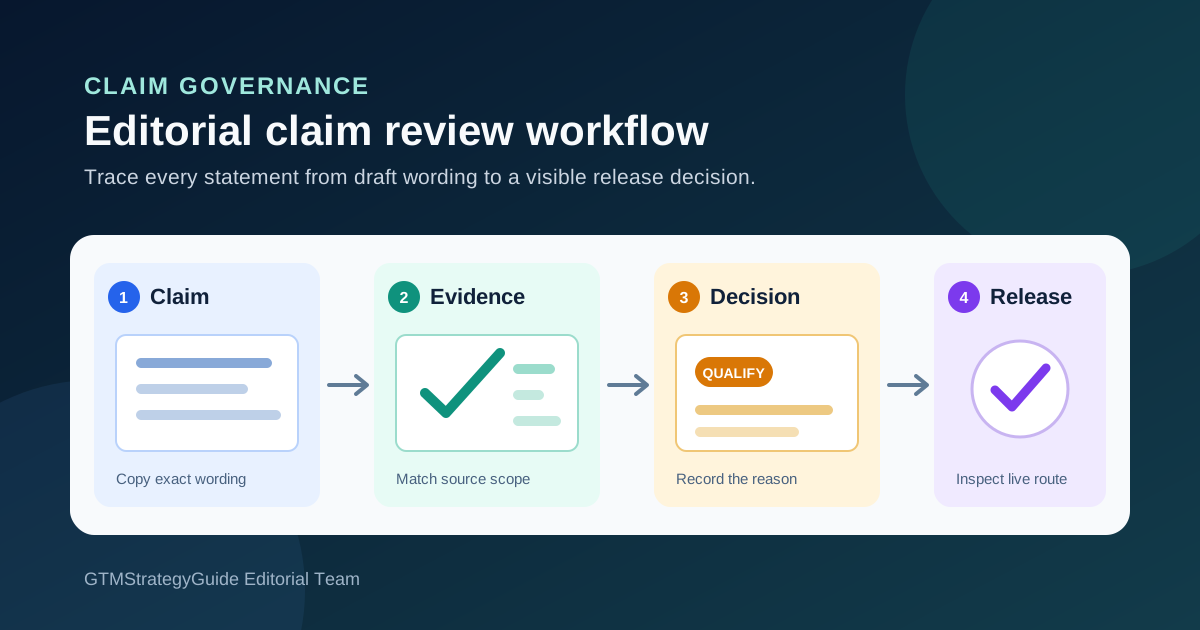
An editorial claim review workflow turns a polished draft back into a set of statements that can be checked. The reviewer marks what the article says, asks what kind of support each statement needs, and records whether the wording should stay, narrow, change, or disappear. This is more reliable than reading for tone and hoping an unsupported sentence feels suspicious.
Claims are easy to miss when they arrive as advice or confident transitions. A sentence can imply that one action causes an outcome without using a number or naming a study. Another can describe a practice as common even though the writer has only seen it inside one team.
Review the meaning, not the polish. Smooth prose deserves the same scrutiny as a statistic, especially when a reader could spend money, change a process, or repeat the statement elsewhere.
Mark the claims before checking sources
Work through the draft in reading order and mark every statement that can be true, false, incomplete, or misleading. Include numbers, dates, product behavior, definitions, comparisons, recommendations, and cause and effect language. Mark broad descriptions too, such as calling a method standard, faster, or widely used.
Give each marked passage a short claim record. Copy the exact wording, name the section, and describe the consequence if it is wrong. A minor definition may need a quick authoritative check, while advice that could change a contract or budget needs more careful review and a narrower scope.
Do not search for sources yet. First capture what the sentence actually asserts. Searching too soon makes it tempting to accept the first related page, even when that page supports a nearby idea rather than the words in the draft.
Classify fact, advice, calculation, and interpretation
The claim type determines what the reviewer must inspect. A factual claim needs evidence that matches its subject, time, and scope, while a calculation needs visible inputs and a method another person can reproduce. Advice needs a stated context so the reader knows when it applies and which tradeoff it accepts.
Interpretation needs the clearest boundary. The writer may draw a reasonable conclusion from several observations, but the source does not automatically say what the writer says. Label the conclusion as an interpretation and keep the underlying observations separate in the record.
One sentence can contain more than one type. Split a passage when its first half reports a documented change and its second half predicts what the change will do. The supported fact can remain even if the prediction has to be removed.
Match evidence to the exact wording
Open the original source and read enough context to understand its limits. Check the publisher, publication or update date, population, definitions, and any qualification that changes the claim. A reputable source can still be wrong for the sentence when it covers another country, product version, audience, or period.
Record the direct URL and write one note explaining what the source supports. This note should be specific enough for a later editor to reopen the page and reach the same decision. If the source only supports part of the sentence, mark the unsupported part instead of treating the citation as a blanket approval.
Prefer primary material when it is available and readable. A secondary explanation may help the editor understand the issue, but it should not replace the policy, dataset, standard, or product documentation that the claim depends on.
Choose keep, qualify, rewrite, or remove
The review decision should change the copy when the evidence demands it. Keep wording that fits the source and the article context. Qualify a statement when the source supports a limited audience, date, condition, or degree, and rewrite it when the idea is sound but the draft overstates the relationship.
Remove a claim when no source fits its actual scope. A nearby citation is worse than a clean deletion because it gives the reader false confidence and makes later maintenance harder. The writer can also replace a sweeping statement with the concrete observation that prompted it, provided that observation is documented.
Save the reason beside the decision. A terse approved label tells the next editor very little. One plain sentence about the evidence and the chosen boundary makes a later update faster and prevents an old version from returning during another rewrite.
Review links, labels, and page context
A source link must be visible where a reader can connect it to the supported statement. Check the anchor text and surrounding paragraph after editing. A citation collected at the bottom of a long article can be hard to map back to one qualified sentence, especially when several claims use similar language.
Read the title, description, H1, image text, and FAQ answers as claims too. Editors often focus on body copy while a stronger promise survives in metadata or a summary card. The page should not make a broad claim in its search preview and quietly narrow it after the reader arrives.
Use the messaging claim inventory for promises shared across several pages, and run the newsletter editorial quality check when the same wording enters distribution. A correction in one article is incomplete if copied versions still carry the rejected claim.
Close the review on the rendered route
Before release, confirm that every marked claim has an owner and a recorded decision. Check that accepted source URLs resolve, citation notes still match the final wording, and removed claims have not survived in FAQs, metadata, image labels, or structured data. Then run the content and repository validators required for the route.
After release, request the canonical page and inspect the rendered passages and links. Confirm the visible byline, modification date, title, H1, media text, source link, and canonical tag. Source data can be correct while a component renders an older field or omits the qualification that made the statement safe.
Close the record with the immutable release reference, reviewer, verification time, and any trigger for another check. A trigger might be a policy update, a new product version, or a source revision. Do not schedule a review simply to create activity; tie it to the part of the claim that can change.
Sources
- Creating helpful, reliable, people-first content, Google Search Central. Supports checking for clear sourcing, factual errors, trustworthy presentation, and evidence of expertise during editorial review.
Related GTM guides
Frequently asked questions
Which statements belong in an editorial claim review?
Mark any statement that can be false, incomplete, or misleading. That includes facts, numbers, dates, comparisons, calculations, recommendations, predictions, broad descriptions, and claims implied by titles, metadata, image text, or FAQ answers.
Can one citation support several claims?
Yes, when the source directly supports each statement and the connection is clear to the reader. Record the supported wording for every claim. Do not treat a reputable source as approval for nearby advice or a broader conclusion it does not make.
When should an unsupported claim be removed?
Remove it when no credible source matches its wording, scope, audience, and time period. You can keep a narrower documented observation or clearly labeled interpretation, but a related citation should not be used to make the original statement appear supported.