
FAQ section editorial standard
A practical standard for choosing useful questions, writing direct answers, and keeping an article's FAQ section consistent with every published representation.
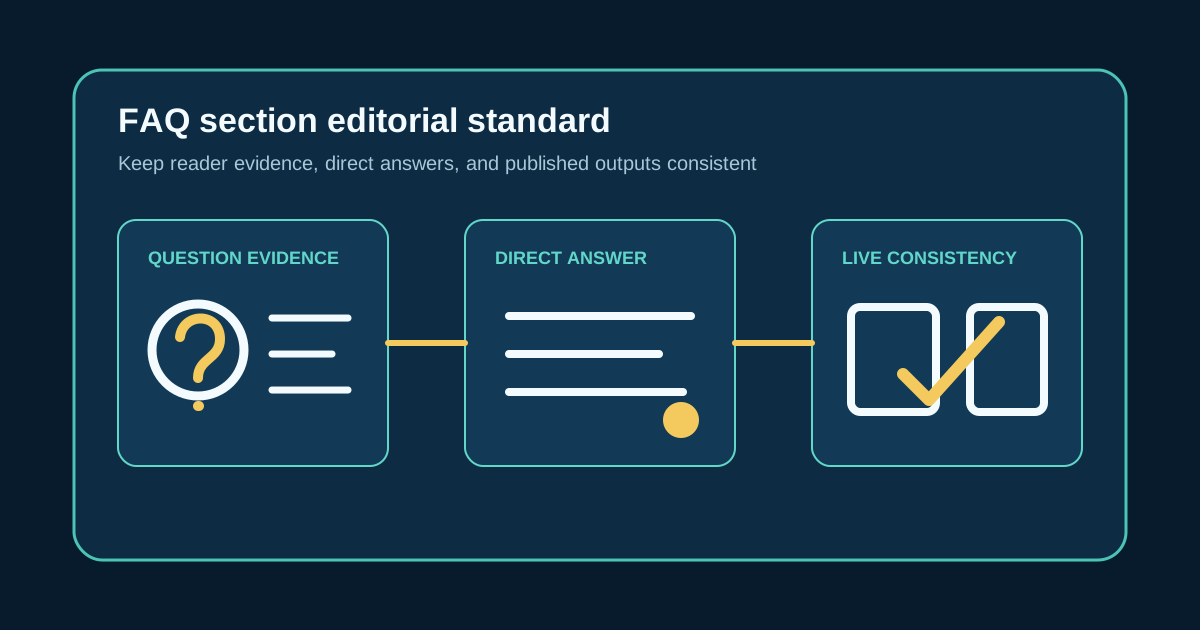
FAQ section editorial standard
An FAQ section editorial standard decides which questions belong at the end of an article and what a useful answer must do. It is not a request to restate every heading as a question. A good section resolves the few points that may still block the reader after the main article has done its job.
Start with evidence of uncertainty. Review brief notes, editor queries, search language, support records, and the places where a test reader paused or made the wrong assumption.
Record the origin of each candidate question and the reader decision it affects. If the team cannot explain why someone would ask it after reading the article, cut it rather than using the FAQ to make the page look complete.
Choose questions after the article has an answer
Draft the article before finalizing the FAQ list. A brief can suggest likely questions, but the finished copy reveals which ones were answered in the body and which useful edge cases remain. This order prevents the FAQ from becoming a second outline written before the real explanation exists.
Keep a question when its answer clarifies a boundary, exception, ownership decision, required input, or next action. Remove questions that repeat the title, define a term already explained nearby, or exist only to fit another keyword variation.
Combine candidates that lead to the same answer. Several lightly reworded questions create scanning work without giving the reader more information, while one specific question makes the editorial promise easier to test.
Write the direct answer first
The first sentence should answer the question in plain language. Put conditions and exceptions immediately after it, then stop when the reader has enough information to act. Do not open with a broad summary of the topic or praise the importance of asking.
Make the answer stand on its own without pretending it is a separate article. A reader who jumps to the FAQ should understand the decision, but the answer does not need to repeat every example, source note, or implementation step from the body.
Use the same terms as the article. If the main copy calls a record an editorial brief, the FAQ should not rename it a content request form merely for variety, because that makes one object look like two different requirements.
Use links only when they continue the task
An internal link belongs in an answer when another guide handles the reader's next task in more detail. The anchor should name that task or destination. A vague prompt to learn more makes the reader inspect a link before knowing whether it is relevant.
Do not send the reader away for the core answer. Give the decision first, then link to a template, full method, or related check that would make the paragraph too long if reproduced here.
Check the destination as part of review. The linked page should still serve the promised task, use a stable canonical route, and avoid contradicting the shorter answer that introduces it.
Review evidence, tone, and claim scope
Treat an FAQ answer like any other published claim. Identify which sentences are editorial advice and which depend on an external fact, product behavior, rule, or dated source. Narrow or remove wording when the available evidence does not support its full scope.
Watch for answers that sound more certain than the article. Words such as always and never need a real rule behind them, while time promises and outcome promises should not be used to make a routine sound easier than it is.
Read the questions aloud in sequence. Repeated openings, identical answer lengths, promotional language, and tidy lists built from the same sentence pattern usually signal that the section needs an editor, not another question.
Keep visible content and machine output consistent
The visible FAQ is the governing editorial copy. If the publishing system sends the questions or answers into another feed, script, search index, or structured representation, compare that output with the rendered page character for character where exact parity is required. A stale answer in one representation leaves two versions of the same guidance in circulation.
Do not add FAQ markup solely to chase a search treatment. Google Search Central recorded in June 2026 that it removed the FAQ rich result documentation because the feature is no longer shown in Google Search results. The section still needs to help readers, but its value should not depend on a retired display feature.
Keep the page's normal Article metadata accurate and test any additional representation the repository actually produces. If no FAQ specific machine output exists, record that fact rather than manufacturing one to satisfy a checklist.
Validate the release and maintain the questions
Before release, compare the accepted question list with the rendered route. Check wording, order, answer text, links, heading levels, keyboard access, mobile reading, and the page source or generated data that carries the same content. Confirm that each answer remains within the claim and source decisions approved for the article.
Request the live canonical URL after deployment. Make sure the expected FAQ appears once, links resolve to the intended destinations, and cached or generated representations do not retain an older answer.
Review the section when the article changes materially or when new reader evidence shows that a question is no longer useful. Preserve the reason for adding, revising, or removing a question so maintenance follows reader needs instead of page length or habit.
Sources
- Latest documentation updates: removing the FAQ rich result feature, Google Search Central. Documents the June 2026 removal of FAQ rich result documentation because the feature is no longer shown in Google Search results.
Related GTM guides
Frequently asked questions
How many questions should an article FAQ include?
Use only the questions supported by real reader ambiguity that remain useful after the article is complete. Three specific questions can be better than a long list that repeats headings, but the editorial evidence should determine the count rather than a fixed quota.
Should an FAQ answer repeat the article body?
No. Answer the question directly and include the condition, exception, or next action the reader needs. Link to a deeper internal guide when it continues the task, but do not withhold the core answer or reproduce a full section.
Does an FAQ section need FAQ structured data?
Not automatically. Publish useful visible questions first, follow the repository's current schema policy, and verify every machine representation that actually exists. Do not add markup merely to pursue Google's retired FAQ rich result feature.