
Internal link opportunity map
A page-by-page method for finding useful internal links, choosing honest anchor text, and verifying the path after publication.
internal link opportunity map
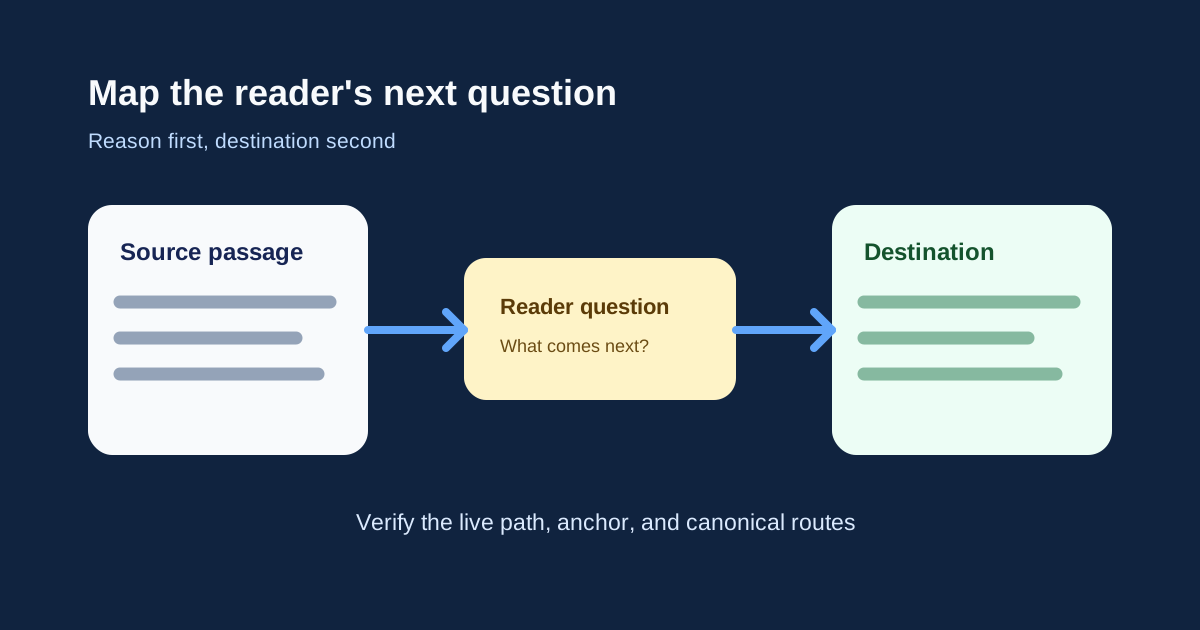
An internal link opportunity map connects a specific passage to a page that answers the reader's next question. It is not a list of URLs that happen to share a keyword. The map records why the link belongs in that location, what the destination promises, and how the reader benefits from following it.
Start with the source page as it exists now. Mark the paragraph where a reader might need a definition, procedure, comparison, or related decision. A link is useful when the destination continues that thought without forcing the surrounding sentence to advertise it.
This approach produces fewer candidates than a sitewide keyword export. That is fine. A short map of defensible links is easier to review than hundreds of matches that ignore meaning.
Begin with unresolved reader questions
Read the source page in order and note where it assumes knowledge. Perhaps a checklist tells the reader to validate metadata but never explains the validation process. Perhaps a planning guide mentions search intent while leaving the classification step elsewhere.
Write the missing question beside the passage before searching the site. This keeps the work grounded in the article rather than in a tool's similarity score. It also gives the reviewer a plain reason to accept or reject the proposed link.
Do not create a question merely because a destination needs more inbound links. If the source paragraph already completes the task, an extra link can distract from the answer. The destination must earn its place in the reading path.
Find a destination that actually continues the task
Search titles, headings, route summaries, and the rendered body for pages that address the missing question. Open each candidate. A promising title is not enough when the article has changed, the useful section was removed, or the route now serves a different audience.
Compare the destination's H1 and opening answer with the proposed context. Then inspect the relevant section instead of assuming the whole page is suitable. Reject a destination that repeats the source page without supplying the next step.
Check route status too. A draft, redirected URL, canonical mismatch, or page scheduled for retirement is a poor destination even when the copy fits. Use the stable canonical route that the site intends readers and crawlers to request.
Write anchor text inside a real sentence
Anchor text should tell the reader what is on the other side of the link. Google Search Central recommends descriptive, concise wording that is relevant to both pages and notes that surrounding words provide context. Generic labels such as read more rarely explain the destination on their own.
Draft the full sentence, not just the linked phrase. This catches awkward keyword insertion and links that have no grammatical relationship to the paragraph. Read it aloud once; forced wording is usually obvious when the surrounding prose is heard as a sentence.
Avoid turning every instance of a phrase into the same link. The first occurrence may be a definition while the later one supports a different point. Choose the placement where the destination solves the clearest reader need.
Review the map as a set of paths
A spreadsheet row can look sensible while the page becomes crowded. Review all proposed additions on the rendered source page. Links placed beside one another are harder to distinguish, and several destinations may compete for the same next question.
Look at destination concentration across the batch. A pillar page may deserve several relevant links, but automatic repetition can make every article end with the same path. Preserve topic-specific siblings when they give the reader a closer answer.
Also inspect reciprocal and circular patterns. Two pages may reasonably reference each other when each handles a distinct step. A loop that sends the reader between near-duplicate explanations signals a content architecture problem, not a linking opportunity.
Publish with route-level checks
For every accepted row, store the source URL, destination URL, anchor text, surrounding sentence, placement, and review reason. This record makes the change reproducible and protects the editor from rebuilding context after a failed release.
After the build, request both routes. Confirm that the source contains a normal anchor element with an href, the destination returns successfully, and both canonical tags identify the intended URLs. Inspect the rendered anchor text because a component can alter or omit content that looked correct in the source data.
Check the mobile layout as well. A valid link can still be difficult to use when it wraps into a dense run of adjacent anchors or sits inside an element that obscures focus. Technical crawlability and readable placement belong in the same acceptance check.
Maintain links when pages change
An opportunity map becomes stale as routes move and articles are rewritten. Give each accepted link a review trigger such as destination retirement, canonical change, major consolidation, or removal of the section that supplied its context. A calendar alone cannot tell you whether the relationship still holds.
When a destination redirects, do not update the href blindly. Open the new page and decide whether it answers the original question. A technically successful redirect may lead to a broad category page that no longer continues the reader's task.
Remove links that have lost their purpose, even if they still return a successful response. Close the record with the live source, live destination, verification date, and decision. The map is trustworthy only when its reasons match what readers can see.
Sources
- Link best practices for Google, Google Search Central. Supports the use of crawlable anchor elements, descriptive and concise anchor text, natural surrounding context, and relevant internal links that help readers discover related pages.
Related GTM guides
Frequently asked questions
How should an internal link opportunity be prioritized?
Prioritize the link that resolves a clear question in the source passage and points to a stable page with a more complete answer. Traffic and link counts can inform review, but they do not replace the reader-path reason.
Should every matching keyword link to the same page?
No. Judge the meaning of each sentence and the task handled by the destination. Repeated automatic links can crowd the article, create unnatural anchor text, and send readers to a page that does not fit that occurrence.
What should be verified after adding an internal link?
Request both canonical routes and inspect the rendered source. Confirm a crawlable href, accurate anchor text, a successful destination, correct canonical tags, usable placement, and a destination that still answers the recorded question.