
Organic landing page message check
A practical review for comparing a search result promise with the title, H1, opening answer, proof, and next action on its landing page.
organic landing page message check
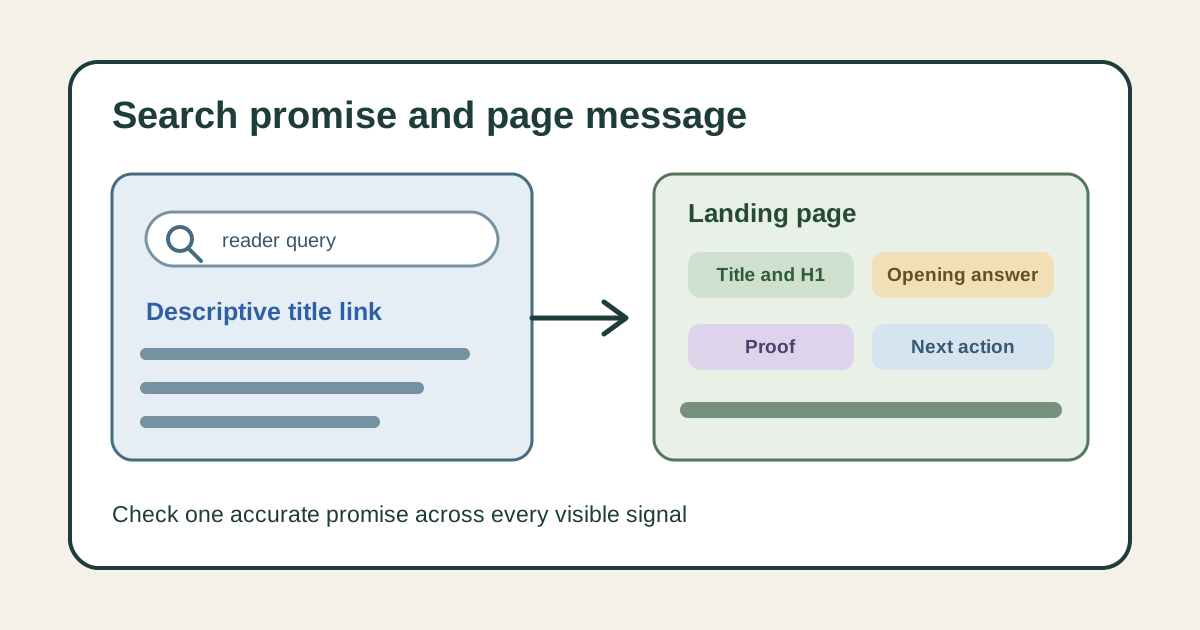
An organic landing page message check compares what a search result appears to promise with what the destination delivers. A page can earn visibility for a useful phrase and still disappoint the visitor if its title, description, H1, opening answer, evidence, or next action points to a different task.
Run the check on one canonical route and a dated query sample. Record the query, country, device, result date, visible title link, snippet, route, page title, H1, opening copy, primary proof, and the action a reader can take after understanding the page.
Keep the search observation separate from the editorial decision. A result page can change, and Google may generate a title link or snippet from several signals, so a captured result is evidence of one appearance rather than a permanent description of the route.
Write the reader task before judging the copy
State what a reasonable visitor using the sampled query is trying to learn or do. Avoid broad labels such as informational or commercial when the actual task is more specific, such as comparing two approaches, finding a definition, checking fit, or starting a setup process.
Then write the page's intended task without looking at the query statement. If the two tasks differ, decide whether the route is an accidental match, a weak but repairable answer, or a page that should stay focused on another audience. Ranking for a phrase does not require the page to adopt every possible interpretation of that phrase.
Name the boundary too. A guide may help someone evaluate a method without offering a purchase flow, while a service page may explain fit and lead to a contact action without pretending to be an independent comparison.
Compare the visible search promise
Read the title link and snippet together. Mark the audience, task, scope, format, and any implied proof or freshness. Words such as checklist, template, pricing, examples, or calculator create concrete expectations that the destination should meet in a usable form.
Do not assume the search appearance reproduces the HTML fields exactly. Google Search Central says title links may draw from the title element, main visual title, headings, prominent page text, anchor text, and other sources. Its guidance recommends concise, descriptive titles that accurately distinguish the page.
Inspect the source signals that may have shaped the result. Compare the title element, H1, open graph title, large headings, internal anchor text, and links pointing to the route when that data is available. Conflicting signals deserve repair even when the sampled result happens to look acceptable.
Read the landing page in order
Start at the rendered mobile page, not the content record. Check whether the H1 confirms the same subject as the result and whether the first useful paragraph answers or frames the reader's task before navigation, promotional copy, or a long scene setter takes over.
Follow the page through its headings. Each section should advance the promised task rather than collecting related keywords. If the title promises a decision framework, the body needs criteria and a way to use them, not a general essay that mentions the same nouns.
Look at the final action in context. A call to contact the company may be appropriate after the page explains fit and limits, but it should not replace an answer the search result already promised. Educational pages can offer a deeper guide or relevant service without turning every section into a sales transition.
Match proof to the message
List the factual and comparative claims that support the page promise. For each one, note the direct source, qualification, and where the evidence appears on the rendered page. Remove or narrow wording when the available material supports only part of the claim.
Separate product facts from editorial advice. A clear recommendation can be useful when the reasoning is visible, but an opinion should not borrow certainty from an unrelated citation. Avoid unnamed authority, invented outcomes, and claims that depend on private customer context the reader cannot inspect.
Check whether the result language creates proof the body does not have. Terms such as best, fastest, complete, or proven raise the burden even when they appear only in a title or description. Replace them with a specific, supportable description of the page's scope.
Choose the smallest honest repair
When the mismatch is narrow, edit the signal that caused it. A vague title can become more descriptive, an H1 can name the actual task, or the opening can answer the query before giving background. Preserve the canonical route when its identity and reader task remain stable.
A broader mismatch needs a route decision. Keep the page focused and accept that it may not serve the sampled query, revise it when the intended task genuinely overlaps, or create a separate brief when two audiences need different evidence and actions. Do not combine unrelated tasks merely to retain one search appearance.
Record the old and proposed title, description, H1, opening, proof, and next action. Tie approval to the exact revision so a later edit cannot inherit a decision made for different copy.
Verify the release and revisit the sample
Before release, render the canonical route and inspect its title, description, H1, first answer, links, media, schema, indexability, and sitemap ownership. Confirm that the Blog index presents the same route identity and that no alternate route competes with a conflicting canonical or duplicate message.
After deployment, request the live page and save the deployed revision, response, canonical, metadata, and visible content. Search appearance may take time to change after recrawling, so publication proof must come from the live route and deployed tree rather than an immediate result page check.
Repeat the dated query sample when a new result is available. Compare it with the earlier capture, but judge the page by whether it makes an accurate promise and completes the intended reader task, not by whether every search display uses the preferred wording.
Sources
- Influencing your title links in search results, Google Search Central. Documents the signals Google may use for title links and recommends concise, descriptive title text that accurately represents each page.
Related GTM guides
Frequently asked questions
What should an organic landing page message check compare?
Compare a dated query and visible search result with the canonical page's title, description, H1, opening answer, supporting evidence, and next action. Record country, device, route, and result date so the observation can be reproduced.
Should a landing page change whenever it ranks for a new phrase?
No. First compare the searcher's task with the page's intended task. Revise the page only when the overlap is genuine and the new wording remains accurate for its audience, evidence, and route identity.
How do you verify a repaired landing page message?
Inspect the rendered route before release, then request the live canonical page after deployment and verify its metadata, H1, opening, proof, links, media, schema, indexing, and sitemap ownership. Treat later search results as dated observations rather than publication proof.