
SEO title rewrite review
A careful review process for changing page titles without confusing a traffic signal, a search result, and the promise made on the page.
SEO title rewrite review
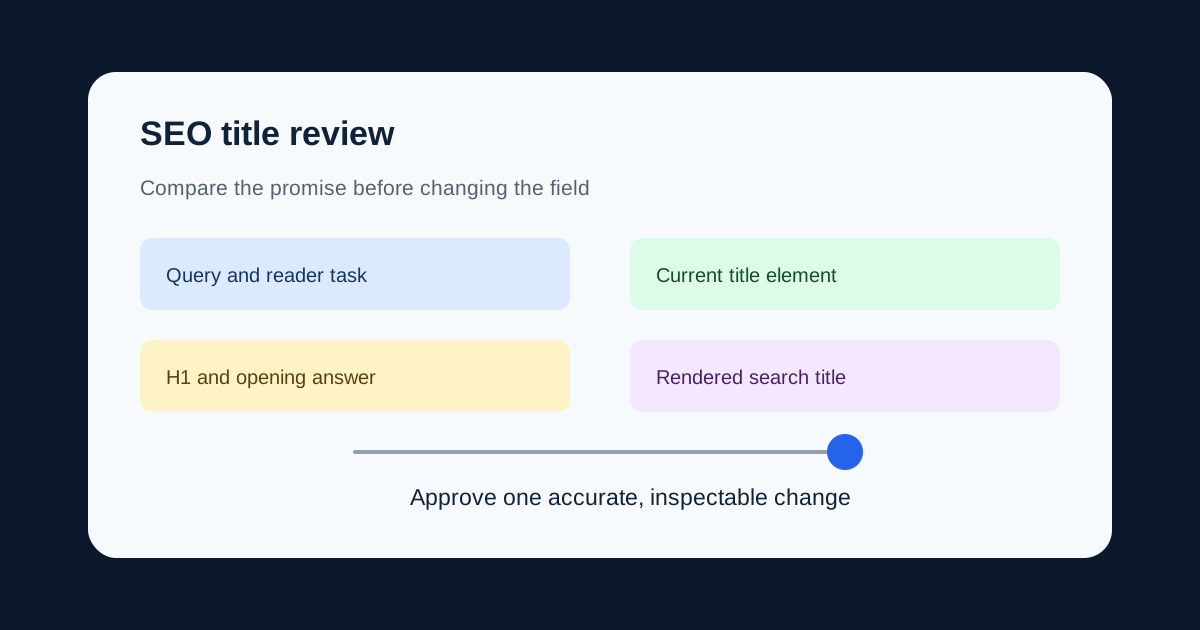
An SEO title rewrite review asks a narrower question than how to get more clicks. It checks whether the title accurately identifies the page, matches the reader task, and agrees with the visible page before anyone changes it. That scope keeps a weak diagnosis from becoming a misleading promise.
A click rate change is a reason to investigate, not proof that the title caused the movement. The query mix may have shifted, the result may appear in a different position, or the search results around it may now answer the task in another way.
Preserve the date range, country, device, query set, page, position, impressions, and current search appearance. Without that context, the review cannot distinguish a title problem from a measurement or demand change.
Read the result and the page together
Open the canonical page before drafting alternatives. Compare the title element, H1, opening answer, major sections, and the action a reader can complete. A title that sounds attractive but promises a comparison, template, or result the page does not provide should fail review.
Next, inspect the search result for the queries under review. Record the title link that is actually shown, because it may differ from the title element in the source. Google explains that title links can draw from the title element, the main visual title, headings, prominent page text, anchor text, and other references to the page.
That means a source edit and a visible result are not interchangeable facts. The reviewer should save both, then note whether the displayed title appears stable across the relevant query set or varies with context.
Write one testable reason for the edit
A useful title brief states what is wrong in plain language. The current wording may be vague, omit the task, repeat boilerplate, conflict with the H1, or describe an older version of the page. Choose the problem that the evidence supports instead of attaching every possible concern to one edit.
Write the expected mechanism beside it. For example, replacing a vague noun with the specific task may help a reader distinguish this result from another page on the same site. That is a rationale for the wording, not a prediction that traffic or ranking will rise.
Reject rationales built only around power words, urgency, or an arbitrary character count. A concise title can still be inaccurate, and a longer title can still state the page purpose clearly. The page promise comes first.
Draft titles against fixed constraints
Keep the canonical route, focus topic, reader task, and page scope visible while drafting. Produce a small set of candidates that express the same honest promise in meaningfully different ways. If every option merely swaps an adjective, the review has not explored the real wording decision.
Check for duplicated title text across the site. Repeated boilerplate makes pages harder to distinguish, especially when several results from the same domain appear together. Branding can remain concise, but it should not crowd out the part that explains this particular page.
Read each candidate beside the H1 and opening paragraph. They do not need to match word for word, yet they should identify the same subject and task. If the strongest candidate exposes a mismatch, fix the page or narrow the title instead of hiding the gap.
Review risk before approval
Title edits can alter more than a search snippet. The same field may feed browser tabs, social previews, feeds, internal cards, and structured metadata. List those consumers in the review so a short search-focused phrase does not create an awkward or false label elsewhere.
Pause approval when the candidate adds an unsupported outcome, price, date, comparison, location, or audience. Also stop when the page has competing H1 elements, stale Open Graph text, or a canonical mismatch. Those defects make it difficult to judge which title signals will be rendered and discovered.
An unresolved display difference is not an excuse to keep rewriting. Search systems can choose a title link from several sources, and processing an update takes time. Record the uncertainty and avoid stacking more edits before the first one can be inspected.
Publish one controlled change
Log the exact old title, accepted new title, editor, review date, reason, and affected route. If other page elements must change to restore consistency, list them explicitly rather than allowing an unnoticed broad rewrite. This keeps the release diff tied to the approved decision.
After the build, inspect the generated title, canonical tag, H1, description, Open Graph title, and Article schema. Request the route directly and confirm that the title is present in the returned HTML, not only in a client-side editing interface. Check the blog index and any internal cards that reuse the field.
Release only when the rendered page tells one coherent story. A green build proves that code compiled. It does not prove that the title describes the page or that every metadata consumer received the intended value.
Evaluate without inventing certainty
Set the observation window and comparison method before looking at the outcome. Use the same page and query group, preserve device and country filters, and note releases or search changes that could affect interpretation. A short window with sparse impressions should not support a confident editorial conclusion.
Compare the rendered title with the title links that appear after the page has been recrawled. If the displayed wording differs, inspect the H1, prominent text, internal anchors, and other title sources before changing the title element again. The difference can reveal an inconsistent page, but it does not identify a single cause by itself.
Close the record with the observed result, limitations, and next decision. Keep null or mixed outcomes. A title review is useful when it leaves the page more accurate and the reasoning more inspectable, even when search performance does not move.
Sources
- Influencing your title links in search results, Google Search Central. Documents title-link sources and recommends descriptive, concise, distinct title text that agrees with the page's main visual title and content.
Related GTM guides
Frequently asked questions
Does a lower click rate prove that an SEO title needs rewriting?
No. Preserve the query set, position, impressions, device, country, date range, and visible result first. A change in demand, ranking, result features, or query mix can move the rate without the title being the cause.
Should the title element and H1 use identical wording?
They can differ, but both should identify the same page subject and reader task. Review the opening answer and major sections too, because a title should not promise material that the page does not contain.
What should stop a title rewrite release?
Stop when the candidate adds an unsupported claim or when the rendered title, H1, canonical, metadata, and page scope disagree. Resolve those conflicts and verify the returned HTML before publishing.