
Subject matter expert interview brief
A practical brief for turning an expert interview into accurate, attributable material that answers a defined reader question.
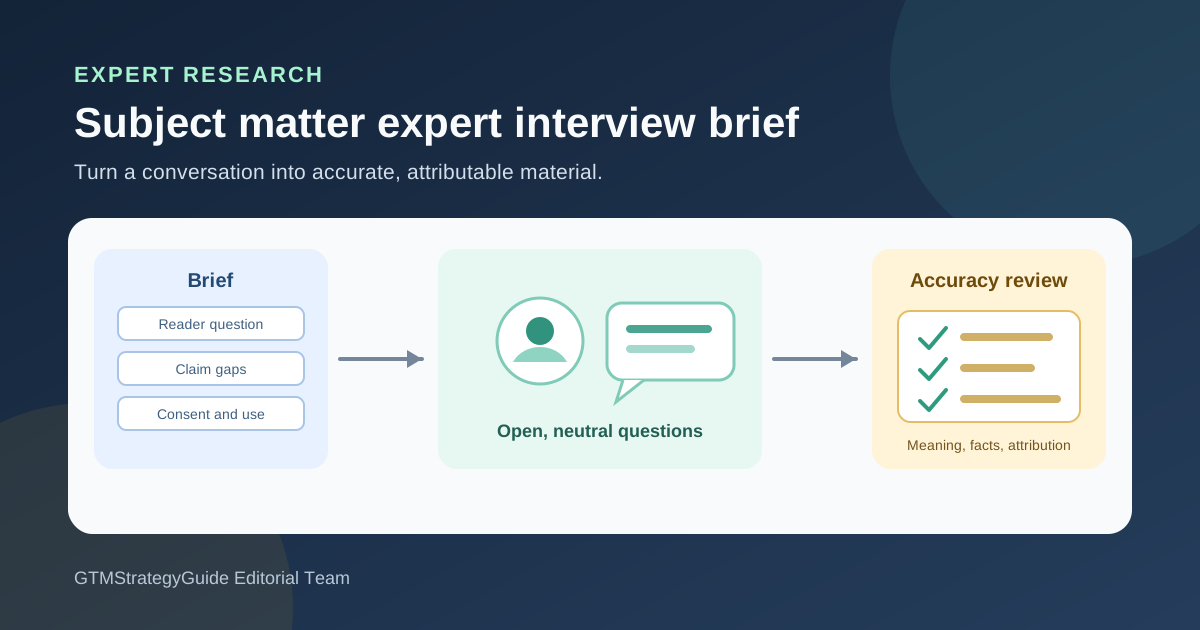
subject matter expert interview brief
A subject matter expert interview brief tells the interviewer and the expert what the conversation needs to produce. It names the reader, the article decision, the evidence gaps, and the planned use of the expert's words. Without that preparation, a lively call can leave an editor with anecdotes that do not support the draft.
The brief narrows the assignment without scripting the answer. It leaves room to correct the premise, add context, or limit a conclusion that exceeds the expert's experience.
Write the brief before scheduling. Listing the missing claims often reveals that some questions belong in published documentation, product records, or a primary source rather than in a conversation.
Define the editorial decision first
Start with one sentence describing what the reader should understand or do after reading the article. Then list the parts of that outcome that the current research cannot support. A broad request such as share your thoughts on content operations gives the expert no way to judge which experience is relevant.
Turn each gap into an editorial decision. You may need to learn when a team should pause a release, how an operator distinguishes two similar problems, or which exception changes a normal workflow. Those questions lead to usable material because the answer has a known place in the article.
Include the intended audience and what the draft assumes they already know. An explanation for a first time content lead will need different terms and examples than one written for an experienced search editor. The expert can then flag jargon, missing context, or a premise that only makes sense inside one company.
Send useful context without coaching the answer
Share the article question, audience, planned format, interview length, participants, and how the material may be attributed. Include a short list of topics and claim gaps, but avoid sending polished statements that invite agreement. Asking whether a prepared claim is correct can turn the interview into approval theater.
Tell the expert whether you want a recording, a transcript, written notes, or a combination. Explain who will have access, how long the working material will be retained, and what review the expert will receive. Confirm consent before recording starts even when the calendar invitation mentioned it.
The government service manual recommends a discussion guide with an introduction script, interview topics, starter questions, possible follow ups, and a planning checklist. It also advises interviewers to decide how sessions will be recorded and to obtain informed consent. That structure creates consistency without forcing every conversation through identical wording.
Write questions that produce inspectable answers
Begin with a concrete event, decision, or artifact. Ask the expert to describe the last time the situation occurred, what information was available, who made the call, and what happened next. Specific experience is easier to attribute and qualify than a general statement about what companies always do.
Use neutral wording and keep one question to one idea. What makes this difficult and how should every team solve it combines diagnosis with a universal recommendation. Ask about the difficulty first, probe the conditions around it, and only then ask which response fit that case.
Prepare follow ups that test scope: Was this observed directly? Which part comes from personal experience? What would make the advice inapplicable?
Ask whether a document or public source supports the factual part. These prompts help the editor avoid turning a bounded observation into a market claim.
Keep the interview flexible and traceable
Use the brief as a route map, not a questionnaire that must be read from top to bottom. Listen for terms that need definition, exceptions that change the recommendation, and disagreement with the premise. A useful detour deserves attention when it answers the article question or shows that the question is wrong.
Keep notes tied to the question and time in the recording. Mark direct language separately from your summary, and write uncertainty as uncertainty. If the expert says a practice worked once in a specific setting, do not shorten the note to best practice.
Repeat your understanding during the call when a point carries editorial weight. A plain check such as I heard two separate conditions, is that accurate gives the expert a chance to repair the note while the context is fresh. Record the correction instead of silently replacing the earlier interpretation.
Separate experience, inference, and sourced fact
After the call, label each candidate passage as direct experience, expert interpretation, or externally checkable fact. A personal account can support a description of what the expert encountered. It cannot by itself establish how common the situation is across a market.
Check names, dates, product behavior, regulations, and other verifiable claims against the appropriate primary material. If no source supports the scope, narrow the sentence or remove it. The expert interview adds judgment and lived context, but it does not replace claim review.
Keep disagreement and exceptions in the working notes. Editors often save the cleanest recommendation and discard the conditions that made it honest. Those conditions may be the most useful part for a reader deciding whether the advice applies.
Run an accuracy review with a clear boundary
Return the passages you plan to attribute along with enough surrounding text to show how they will be used. Ask the expert to check factual accuracy, intended meaning, attribution, and confidential details. Give a named deadline and contact so the review does not become an open ended approval round.
Do not ask the expert to own the article's editorial judgment. The editor remains responsible for the conclusion, source coverage, reader fit, and final wording. If an expert requests a promotional claim or a broader conclusion than the evidence supports, keep the narrower version and record the reason.
Track every accepted correction and any unresolved disagreement. A changed quote needs a fresh comparison with the recording or written response, while a changed interpretation needs the editor to revisit the surrounding evidence. Preserve the reviewed passage with its status so later edits do not accidentally restore rejected wording.
Close the interview record after publication
The final record should include the brief version, participants, interview date, consent and recording choice, source file location, candidate passages, accuracy feedback, editorial decisions, and article route. Limit access to raw material according to the agreement made with the expert.
Inspect the published page rather than assuming the approved passage survived the build. Check the byline, expert attribution, links, surrounding qualifications, media, metadata, and structured data on the canonical route. A correct source file does not protect against a cropped quote or a stale page component.
Close the record only when the visible article matches the accepted use. The outcome is not that an interview happened. It is that the reader receives a traceable expert contribution whose experience, interpretation, and factual claims remain distinct.
Sources
- Using in-depth interviews, GOV.UK Service Manual. Supports preparing a discussion guide, using open and neutral questions, deciding how to record, obtaining informed consent, and allowing relevant follow ups during an interview.
Related GTM guides
Frequently asked questions
What should be sent to a subject matter expert before an interview?
Send the article question, intended audience, planned use, interview length, participants, attribution approach, recording choice, and a short list of topics or evidence gaps. Share enough context to prepare without supplying conclusions for the expert to approve.
Can one expert interview support a general market claim?
One interview can support an attributed account or interpretation within the expert's experience. It does not establish prevalence across a market. Verify factual claims with primary material and narrow any statement whose scope exceeds the available evidence.
What should an expert check before publication?
Ask the expert to review the passages you plan to attribute for factual accuracy, intended meaning, attribution, and confidential details. The editor still owns the article's conclusion, evidence coverage, reader fit, and final wording.