
Weekly content refresh queue
A working method for choosing which published pages to inspect, repair, rewrite, or leave alone each week.
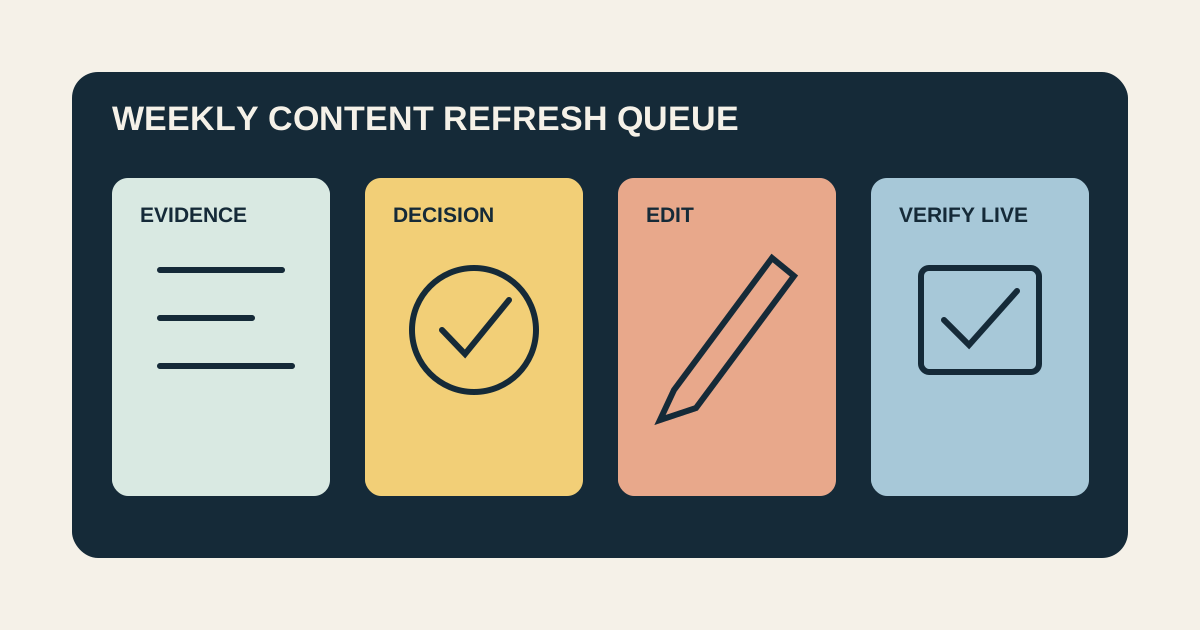
weekly content refresh queue
A weekly content refresh queue is a decision list, not a spreadsheet of pages whose traffic moved. It gives an editor enough context to choose the next useful action without pretending that every decline needs a rewrite. Each row should identify the page, the reader task, the observed problem, the age of the supporting evidence, and the reason the page deserves attention now.
Keep observations separate from explanations. A lower click rate is an observation tied to a query set, date range, device mix, and search appearance.
It does not prove that the title is weak or that a competitor took the visit. When the queue records the measurement and the proposed explanation in different fields, the editor can challenge the explanation without losing the underlying signal.
Choose inputs that reveal reader problems
Start with a small collection of signals that represent different kinds of trouble. Search data can expose changing query language or a page that earns impressions but few visits.
Editorial reviews can find unsupported claims, obsolete screenshots, broken steps, and openings that no longer answer the search promise. Support and sales notes may reveal a question that the article skips even while its traffic looks steady.
Record the source and capture date for every signal. An undated note such as traffic down is hard to reproduce and even harder to prioritize.
A useful entry says which page and queries were inspected, which comparison period was used, and what changed. For an editorial defect, quote the affected passage or name the section so the next person does not have to rediscover it.
Score the work without hiding judgment
A queue needs an ordering rule, but a single score often creates false confidence. Use separate fields for reader consequence, evidence confidence, effort, and release risk, then write one sentence explaining the priority.
A wrong legal or product claim may deserve immediate correction even on a quiet page. A broad rewrite based only on a short traffic dip should usually wait for a stronger diagnosis.
Define the available decisions before the review starts: correct a fact, repair a broken element, add a missing answer, rewrite the page, consolidate it with another route, retire it, or make no change. The last option matters. Leaving a sound page alone is a valid decision when the signal is weak, the task is still served, and another item has a clearer reader consequence.
Turn each queue row into an editing brief
Once an item is selected, replace the vague refresh request with a bounded brief. State what the reader should be able to do after the edit, which evidence needs review, which sections may change, and which parts of the route identity must remain stable. Name any related page that could be affected so the writer checks for cannibalization, duplicated advice, and conflicting internal links.
Do not change the displayed date just because someone opened the file. A modification date should follow a material review or edit that a reader could recognize.
Keep the original publication date in the record, list the passages that changed, and attach the source used for any revised claim. This makes a freshness decision inspectable instead of turning the date into a promotional label.
Protect urgent corrections from large rewrites
A factual correction and a strategic rewrite have different clocks. If a cited instruction is wrong, remove or correct it as soon as the evidence is clear, then verify the rendered page.
Do not hold that repair until a new outline, images, and distribution plan are ready. Link the correction record to the larger queue item so the later editor knows what already changed and why.
The same separation helps with broken links, inaccessible media, and malformed metadata. These repairs can move through a narrow review path while a disputed positioning change waits for the accountable owner.
Give each path its own acceptance check. Combining unrelated work into one large refresh makes failures harder to isolate and encourages reviewers to approve the urgent fix without inspecting the rest.
Review the live result and close the record
A merged edit is not a finished refresh. Request the canonical URL after release and inspect the title, H1, opening answer, changed sections, source link, internal links, media, and visible dates.
Confirm that the sitemap and canonical tag still identify the intended route. If the edit changed structured data or navigation, inspect the rendered output rather than trusting the source component.
Close the queue row with the release commit, verification time, reviewer, and outcome. Add a dated follow-up only when there is a real question to answer, such as whether readers now reach the intended section.
Do not promise that rankings will improve. The record should show what the team changed, why the evidence justified it, and which observation would cause another review.
Run a short weekly review
The weekly meeting should be small enough to make decisions. Review newly admitted items, check work already in progress, and challenge anything that has sat without an owner or a reproducible reason.
When review capacity is full, stop admitting broad rewrites. A long list of started pages hides the cost of evidence checks, media work, build failures, and post-release inspection.
After several cycles, inspect the queue itself. Look for sources that produce noise, priority rules that always favor high-traffic pages, and recurring defects that belong in the publishing standard.
Change one rule at a time and date the decision. The queue becomes more useful when it teaches the team which pages need work and which production habits keep creating that work.
Sources
- Creating helpful, reliable, people-first content, Google Search Central. Supports the review practice of checking whether a page serves its intended audience and provides original, trustworthy help rather than changing content for search signals alone.
Related GTM guides
Frequently asked questions
How many pages should enter a weekly content refresh queue?
Use the number your editors can investigate, revise, review, and verify without carrying half-finished work into the next cycle. Capacity should include evidence checks and live inspection, not just drafting time.
Should a traffic decline automatically trigger a rewrite?
No. Preserve the query set, date range, page set, device mix, and comparison window first. Then check indexing, search appearance, demand, competing releases, and the page itself before choosing an edit.
When is a content refresh complete?
It is complete after the accepted change is live and the canonical route, visible copy, links, media, metadata, dates, schema, and sitemap entry have been checked. Record the immutable release and the verification result in the queue.